Meetings that don't move
Build the Operating Rhythm
Goal-setting, staff meetings, and quarterly reviews that produce decisions instead of status.
See operating rhythm →Home·Special Projects
One piece at a time. À la carte.
Not every problem needs the whole fractional engagement. Special Projects is the à-la-carte menu — a single, targeted operational fix taken on its own, or an AI-native build of something that doesn't exist yet. Each one is scoped and priced on its own, and taken on when it's a right fit.
When the problem is narrow and defined, I take it on as a standalone project — without standing up the full fractional engagement.
Goal-setting, staff meetings, and quarterly reviews that produce decisions instead of status.
See operating rhythm →Intake, prioritization, reporting cadence, and the discipline to stop work that should stop.
See PMO setup →Find what's actually blocking a late cross-functional effort, resequence it, and hand it back running.
See program recovery →Take manual internal work out of the business. Process first, tooling second, measured on hours returned.
See automation →Working software, not slideware. Tools that put AI inside a real workflow, measured on whether they removed the work.
Internal systems a company needs before it can justify hiring for them. Scoped, built, and handed over documented.
Dashboards, displays, and real-time surfaces that show the state of a business at a glance, instead of buried in a report.
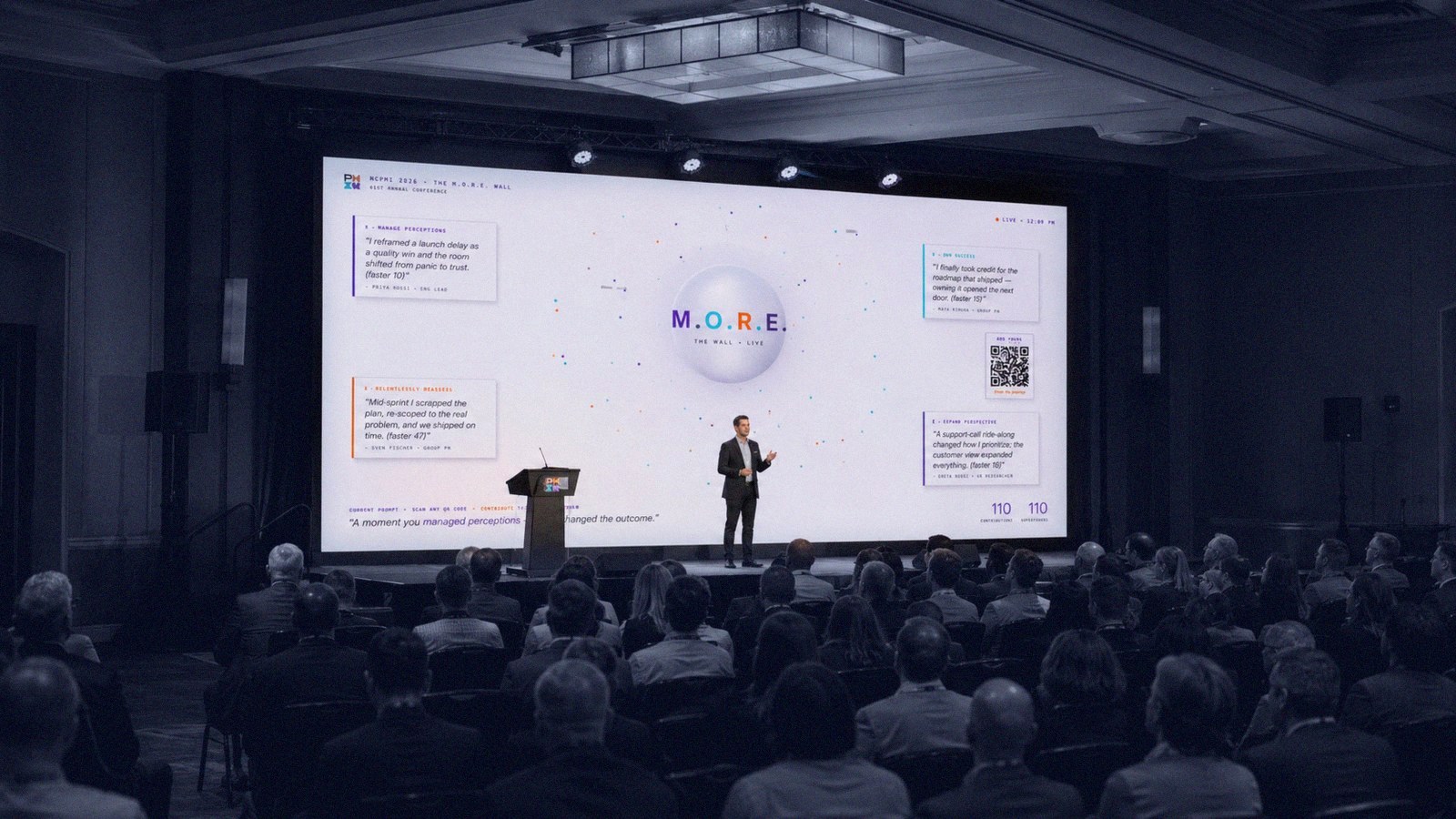
Illustrative, AI-generated image of the M.O.R.E. Wall in use.
A live, moderated audience-participation display for a 400-person conference — built by one person, over four weekends, on about $25 of hosting. Attendees answer the active prompt on their phone; once a moderator approves it, their words hit the big screen in about two seconds.
Two kinds. Targeted operational engagements — standing up a PMO, building the operating rhythm, recovering a stalled program, or automating internal work — taken on their own when you don't need the full fractional engagement. And AI-native builds: tools, internal systems, and real-time interfaces that don't exist yet.
One at a time. Each project is scoped and priced on its own, and taken on only when it's a right fit — there's no catalog and no standing rate card.
Then it isn't a special project — it's a fractional engagement. Start with the Operating Diagnostic, which finds what's actually in the way before anyone commits to ongoing work.
Working software. AI-native tools are measured on one thing: whether they actually removed the work. If a tool doesn't return hours or replace a manual process, it didn't do its job.
The M.O.R.E. Wall — a live, moderated audience-participation display built for a 400-person conference, by one person over four weekends, on about $25 of hosting. The same scope quoted as freelance work came to 23–29 engineering hours. See the case below.
Twenty minutes, no cost. We'll find the critical path from there.